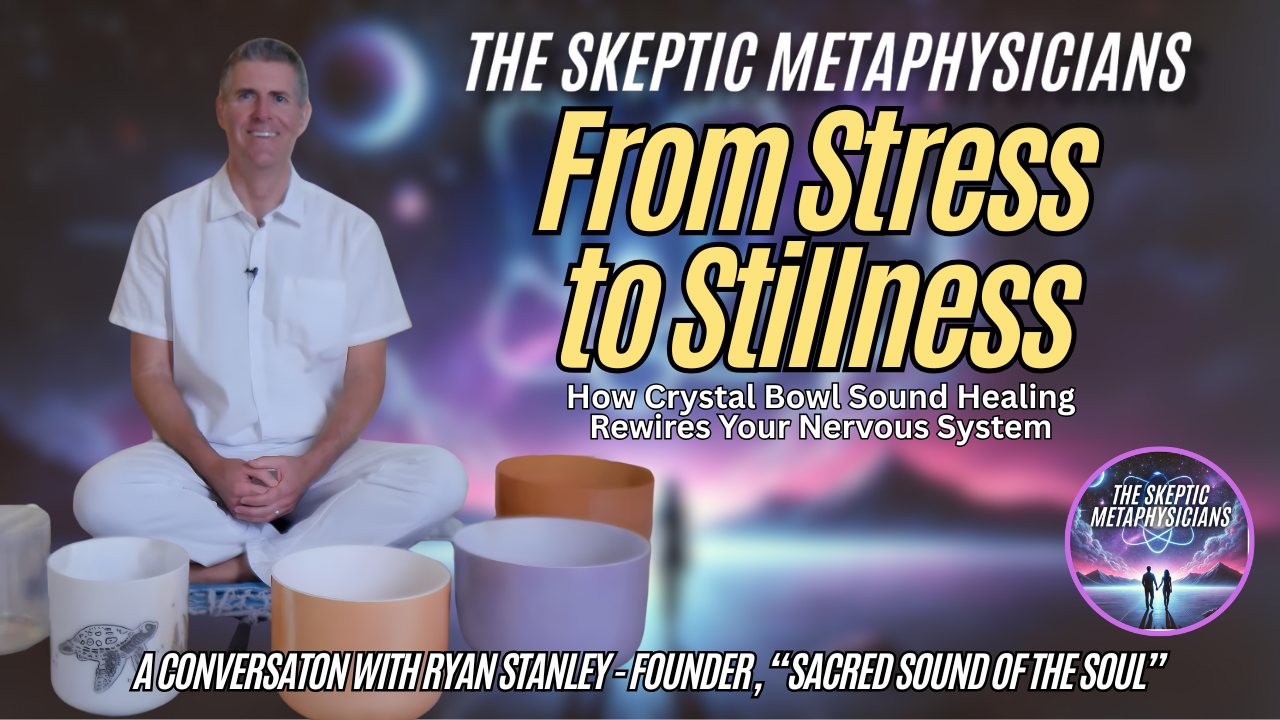
What We Learned When 15 Minutes of Crystal Bowls Changed Everything
Talking to Ryan Stanley made us realize we were approaching sound healing backwards.
We went into the interview thinking crystal bowls were meditation decoration...pretty instruments that help you relax. What we didn't expect was to discover that for thousands of people, sound healing is the only thing that stops them from moving when they can't stop moving. It's the one tool that quiets their nervous system faster than anything else they've tried.
Will described feeling the vibration "everywhere" during Ryan's live sound bath. Karen's sinuses opened. And the part that got us: Karen says she watched a red car drive away while she was standing still. She left her body in 15 minutes. That's not meditation fluff. That's neurobiological transformation.
After a decade of interviewing spiritual teachers, consciousness explorers, and wellness practitioners, we've learned to recognize the difference between inspirational talk and actual physiological change. Ryan Stanley represents something rare: a former corporate executive turned sound healer who refuses to oversell the "woo" while simultaneously acknowledging that his work produces immediate, measurable results.
This is the conversation that changed how we think about stress, intention, and what it really takes to shift your body from "fight or flight" into rest.
The Problem No One Talks About: Stress as Baseline Operating System
Here's what nobody tells you about chronic stress: it becomes invisible.
Most of us don't think of ourselves as "stressed." We just think this is how humans operate. Clenched teeth at our desk. Shoulders up to our ears. That moment when your phone buzzes and your brain instantly catalogs the 30 things you haven't done. We've normalized a state of emergency that would have killed our ancestors.
Ryan called it perfectly in our first conversation: stress has become our baseline operating system. Not crisis-level stress. Just... the way we function now.
The neuroscience backs this up. When you experience chronic stress, your body triggers the sympathetic nervous system and HPA (hypothalamic-pituitary-adrenal) axis, which releases cortisol and adrenaline. In ancestral times, this was useful for maybe 20 minutes when a predator showed up. Your body would flood with these hormones, you'd run or fight, then the threat passed and your parasympathetic nervous system would kick in, the "rest and digest" response that brings your heart rate down, relaxes your muscles, and lets your digestive system work again.
But in modern life, the threat never passes. Your email inbox doesn't close. The news cycle never stops. So your body keeps dumping cortisol and adrenaline, and your feedback mechanisms start breaking down. Your muscles stay tensed (hello, clenched teeth). Your heart rate stays elevated. Your gut stays inflamed. And after months or years of this, your nervous system literally rewires itself around stress.
This is when we typically try everything: meditation apps, CBD, workout regimens, therapy, more coffee, less coffee. We're searching for something that works fast, because who has time for a six-week meditation course when your nervous system is firing on all cylinders?
This is where crystal bowls enter the equation.
The Science of Why Sound Changes Your Nervous System in Seconds
When Ryan played those crystal bowls during our live session, something shifted in our bodies instantaneously. Not eventually. Not after deep breathing exercises. Right away.
Here's why: sound bypasses your thinking brain entirely.
Your vagus nerve, this long, wandering nerve that runs from your brain all the way to your gut, comes to the outer surface of your body in only one place: your outer ear. It's not buried in tissue. It's accessible. And when vibrations from a crystal bowl hit that nerve, they stimulate vagal tone directly.
Higher vagal tone is associated with improved emotional regulation, a stronger immune system, and better overall health. More importantly, it's the neurobiological pathway to stepping out of fight-or-flight and into rest-and-digest. And unlike meditation, which requires you to "achieve" something mental, sound healing works through pure physics. Your nervous system responds to vibration regardless of whether you believe in it.
Research shows that frequencies between 40–150 Hz specifically stimulate the vagus nerve. When that happens, your body activates the parasympathetic nervous system, the branch responsible for slowing your heart rate, deepening your digestion, and allowing actual rest to occur. Your cortisol drops. Your stress hormones begin to settle. And because sound is pure vibration, there's nothing for your resistant, busy brain to fight against.
Ryan explained this through a concept that stuck with us: frequency entrainment. It works like this: a tuning fork vibrating at a specific frequency will cause another tuning fork next to it to vibrate at the same frequency, even without physical contact. Your brain does the same thing. When exposed to stable, rhythmic frequencies, like those produced by a crystal bowl, your brainwaves begin to synchronize with that frequency. If the bowl is playing in an alpha or theta range (associated with calm and deep meditation), your brain literally shifts into those states.
But here's where Ryan challenged the spiritual narrative we were expecting: he said that people hear the bowl where you tell them to listen. He told us this is the most important myth-buster in sound healing.
The Intention Problem: Why Your Bowl Isn't Limited to Your Sacral Chakra
We were fascinated by Ryan's honesty here. He challenged his own spiritual assumptions.
He showed us that a single crystal bowl actually produces an infinite number of frequencies simultaneously. If you run the sound through a frequency spectrometer, you don't see one clean line. You see a graph that peaks in one place but then slowly degrades across a spectrum. Underneath that curve is sound moving in all directions; high frequencies, low frequencies, and everything in between.
So what determines which frequency your body receives?
Your intention.
If Ryan tells you "this bowl targets your sacral chakra," you unconsciously become more sensitive and receptive to the frequencies you imagine would help that part of your body. You envision your sacral chakra, you mentally direct your attention there, and suddenly you feel the vibration more intensely in that location. But that's not because the bowl is magically attuned to that specific chakra, it's because your nervous system is responding to your focused attention.
This is where intention becomes real, measurable, and reproducible, not because of metaphysics, but because of how your nervous system prioritizes input.
Ryan's conclusion floored us: "I believe that each instrument actually has the possibility to reach just about any area of your body that you want to. And I think if we actually did research and testing, it would be that wherever people are listening is where they..." get the benefit.
This is the hybrid space between science and spirituality that actually works. Your intention isn't magical, it's neurological. It's you directing your parasympathetic nervous system to activate where you need it most. Your expectation, combined with the physics of vibration, creates the experience.
And the research backs this up. Studies on mindfulness meditation and placebo reveal something surprising: intention and actual neurobiological change activate different, but equally powerful, neural pathways. Your belief that something will help creates real brain changes, even if those pathways are distinct from the active mechanism of the treatment itself.
So when Ryan says your bowl matching your energy signature matters more than which chakra it's "supposed" to hit, he's not being wishy-washy. He's saying that your body knows what it needs. Trust that.
How to Choose Your Bowl: Energy Signature Over Chakra Charts
This was the practical pivot we weren't expecting.
The conventional wisdom around crystal bowls is: if you want to heal your root chakra, buy a red bowl tuned to C. If you want sacral energy, buy orange tuned to D. There's a color chart. There's a frequency chart. Everything is categorized.
Ryan rejected that framework entirely.
Instead, he described an experience that happened in his own spiritual awakening. He had resisted crystal bowls for years because they didn't feel "masculine" enough to him. Sound healing, he believed, should require mastery; 30 years of Indian classical music study, not 15 minutes of learning to play an instrument.
But one day, he picked up a 16-inch super-grade crystal bowl and played it for three or four hours. He fell into it completely. That night, he couldn't sleep. At 3 AM, he woke with what he described as the biggest samadhi (a transcendent meditative state) of his life. The bowls were in his consciousness all night and into the next morning. All he could think about was wanting to play them again.
He didn't choose that bowl because it was tuned to a specific chakra or frequency. He chose it because something in him recognized it. His energy signature aligned with it.
Ryan's recommendation: walk into a space with multiple bowls (or if buying online, listen to recordings). Play them. See which one calls to you. Which one makes you want to stay. Which one your body settles into. That's your bowl.
In practical terms, this means: don't buy a bowl because it matches a color therapy chart or because a healer told you it would fix something. Buy the one that, when you interact with it, feels like coming home.
Duration: How Long Do You Actually Need to Use It?
This is the practical question that trips people up.
Will mentioned that he plays his sacral chakra bowl for about 30 seconds to a minute, then walks away. He wasn't sure if that was "enough." The implication being: if you're not sitting in sound baths for an hour, are you really getting benefits?
Ryan's answer was refreshing: it depends entirely on your application.
He described a day trader who uses the bowls for 3-4 minutes between market trades. When the chaos and frenetic energy get overwhelming, he sits with the bowl for a few minutes to reconnect with inner clarity and knowing. That's enough. The bowl doesn't need to be a ceremonial practice. It can be a circuit-breaker for your nervous system.
For Ryan personally, 15 minutes is his sweet spot when playing for himself. But he's also done hour-long or 75-minute online sound healings where people lie in bed with headphones, and the effects are profound and restorative.
The research on sound and the parasympathetic nervous system suggests that even short exposures activate the relaxation response. The key is consistency and intentionality, not duration. A three-minute daily practice will reshape your nervous system more effectively than an occasional hour-long session.
What matters is this: if you're only going to use a bowl for 30 seconds, use it 30 seconds on purpose. Not because you think there's a minimum threshold you need to hit, but because you're deliberately interrupting your stress response and asking your body to step into rest.
One Bowl Versus an Orchestra: Why You Don't Need to Buy Everything
Here's where accessibility becomes spiritual practice.
Many people worry that having only one bowl limits their practice. Won't they get bored? Won't they miss the harmonic complexity that comes from playing multiple bowls together?
Not necessarily.
When you play a single crystal bowl with intention, you're engaging in what Ryan called "the dance of receptivity and strength." You're learning how to put minimal effort in and receive maximum return. You play, let the vibration subside, then add more energy. You're in conversation with the instrument. You're listening. There's a pulse, an oscillation, a relationship.
With one bowl, you can play for extended periods without boredom because the relationship is deepening. You're learning how little energy is actually required to generate sound. You're discovering subtlety.
In Ryan's collection, he has 500+ bowls in stock. But that's because he's curating sets for people where every bowl harmonizes with every other bowl. When you play them together, "you never hit the wrong note." It's like having a keyboard where every key sounds beautiful. But that's the professional's approach.
For someone starting out, one bowl is sufficient. One bowl that calls to you, played consistently, for whatever duration you can sustain, with your full attention...that will reshape your nervous system.
The Out-of-Body Experience: Why Online Sound Healing Really Works
The moment that convinced us sound healing was genuinely effective (not just pleasant) was when Karen said: "I pretty much left my body."
Will asked if that was hyperbole. She said no. She was watching a red car drive away from above, outside her body. She wasn't doing meditation breathing exercises. She wasn't lying down. She was in a conversational interview, listening through headphones. And the crystal bowl frequencies literally pulled her out of her body.
This should make sense neurologically, but it blew our minds anyway.
Sound waves are sound waves, whether they're coming through air or through digital transmission. Your vagus nerve doesn't know the difference between a bowl vibrating in front of you and a bowl vibrating through speakers. The frequencies reach your ear canal, stimulate that nerve, and activate your parasympathetic response. The physics doesn't care about medium.
What made this particularly shocking is that we had expected online sound healing to be a lesser experience. A digital approximation. Something that wouldn't compare to being in-person with an actual instrument.
We were wrong.
Ryan explained that if you're listening with good headphones and actually directing your attention to the sound (not multitasking, not half-listening), you're engaging your vagal nerve fully. You might even feel it more deeply than someone in a noisy sound bath where other people's nervous systems are interfering with their focus.
The research on vagus nerve stimulation and sound has shown that pairing VNS with tones creates measurable changes in cortical synchrony and neural plasticity. Your brain literally rewires itself in response to the frequency pairing. That happens whether the tone is live or recorded.
The Tinnitus Question: What Happens If Your Nervous System Already Has Noise
Karen asked one of the most practical questions we heard: "If someone has tinnitus, does the bowl aggravate it or help it?"
Ryan's answer was honest: he'd only encountered it a couple of times, so he couldn't give scientific certainty. But in his experience, gentle sound healing hasn't aggravated tinnitus. Sometimes it's even helped a little. The key is subtlety.
The issue arises when sound baths get too vigorous, when facilitators play bowls really loudly to try to "reach" people or "wake them up." For someone with tinnitus, that aggressive approach can trigger trauma or physical discomfort. But gentle, subtle frequencies seem to work okay.
This points to something important: not all sound healing is the same. A loud, aggressive gong session is different from a gentle crystal bowl session. If you have tinnitus, you need to find a practitioner who understands subtlety. And honestly? If you're sensitive to frequencies, that information about yourself is gold. It means you're neurologically responsive to vibration. You just need to find the right frequency, volume, and approach.
The Crystal Bowl Mechanics: Why Width, Height, and Thickness Matter
Ryan played the musical theory nerd card when explaining how crystal bowls work.
A six-inch bowl creates a fifth-octave C note. The same note in a 12-inch bowl goes two octaves lower. Not because the larger bowl is "deeper", but because of the mathematics of vibration. Larger surface area and height create lower frequencies. Wall thickness also plays a role: thicker walls create higher frequencies, thinner walls create lower frequencies.
This is why Ryan carries 500+ bowls. Every single one is handmade and one-of-a-kind. They don't grind or tune them to specific pitches. The bowls are "born" at whatever frequency emerges during manufacturing. So to build a set where multiple bowls sound harmonious together, he has to search through hundreds of instruments to find combinations that create major triads and harmonic intervals.
The practical takeaway: if you're buying a bowl, size and thickness determine the frequency. A wide, tall, thin-walled bowl will be lower and more subdued. A small, thick-walled bowl will be brighter and higher. Neither is better. It depends on what your nervous system is calling for.
And yes, you can change a bowl's frequency slightly by adding water to it, just like a wine glass...but the effect is subtle. Your bowl's fundamental frequency is baked in.
How to Play: It's Easier Than You Think
One of the barriers people perceive around crystal bowls is that they seem difficult to play. Like, you need training. You need musical experience. You need to know what you're doing.
Not true.
Ryan said it usually takes 2-3 minutes to teach someone how to play a crystal bowl. Within that brief window, they're producing beautiful, resonant tones. And the emotional response is almost always tears, because suddenly they have access to this beautiful sound that they created. Many people who played instruments as children walked away from that part of their identity. And here, instantly, they're making gorgeous music again.
The basic technique: use a suede-wrapped wand or mallet on the rim of the bowl, applying gentle, consistent pressure. As you build momentum, the friction creates vibration. The wand becomes an extension of your intention. It's not hard. It's not complex. It's accessible.
What to Do With All This: Your Action Plan
Let's get practical. If you're reading this and thinking "I want to experience what they experienced," here's how to start today.
If you don't have a bowl:
Find recordings online; Sacred Sound of the Soul has audio samples of most of their bowls. Listen with good headphones, preferably lying down or in a relaxed position. Give yourself 10-15 minutes without distractions. Don't overthink which frequency you "should" listen to. Listen to what calls to you. Notice what your body reports: tingling, relaxation, emotional release, clarity, numbness. All of it is data. Your nervous system is telling you something.
NOTE: Listeners of Skeptic Metaphysicians can use the code SKEPTIC to receive $100 off their first alchemy crystal singing bowl from Sacred Sound of the Soul
If you have a bowl (or get one):
Play it with no agenda except to create vibration. If you have three minutes, use three minutes. If you have an hour, use an hour. The duration is less important than the consistency. Set an intention before you play—not a chakra-specific one, just a statement of what you're opening to. "I'm opening to rest." "I'm opening to clarity." "I'm opening to whatever my nervous system needs right now." Then play and listen to what emerges.
If you're skeptical:
You don't need to believe in energy or spirituality or anything metaphysical for sound healing to work. It's neurobiological. Your vagal nerve doesn't require your permission to respond to frequency. So skip the belief step and just experience it. Notice what changes in your body.
If you want to deepen:
This is where Ryan's insight about intention becomes crucial. As you work with sound healing, practice directing your awareness to specific areas of your body. Listen to where you feel tension. Ask the bowl to meet you there. Not because that's magically how it works, but because your nervous system will respond to your focused attention, and you'll access the frequencies that matter most.
The Bigger Picture: Why This Matters Now
We live in a world where stress has become structural. It's not that you're doing something wrong. It's that the operating system itself is designed to keep you slightly panicked. Your inbox never empties. Your to-do list regenerates. The news is always catastrophic. And your nervous system, which evolved for 300,000 years without email, is breaking under the load.
Most of the solutions offered—meditation, therapy, exercise—are valuable but require effort and cognitive engagement. They require you to do something to achieve relaxation.
Sound healing offers something different. It doesn't require you to achieve anything. You don't have to silence your mind. You don't have to sit in perfect posture. You don't have to believe. You just have to listen.
And in a world drowning in noise, the offer to simply listen, to allow your nervous system to entrain to a frequency that says "rest now", is becoming not just spiritual practice, but survival practice.
Ryan went from crunching numbers to facilitating consciousness through vibration. That's not because he found some mystical secret. It's because he discovered that sometimes the simplest, most accessible tool is the most powerful.
A bowl. A frequency. Fifteen minutes. A rewired nervous system.
That's available to you right now.
Resources
Sacred Sound of the Soul
Website: www.sacredsoundofthesoul.com
Location: Encinitas, California
Services: In-person consultations, online sound healing sessions, bowl selection guidance
Inventory: 500+ unique crystal bowls with audio recordings available online
References and Research
NCBI Bookshelf. "Physiology, Stress Reaction." StatPearls Publishing.
Mayo Clinic. "Chronic stress puts your health at risk." (2023)
Kenhub. "Parasympathetic Nervous System: Anatomy and Functions."
UW Medicine Right as Rain. "What Does Stress Do to Your Body?" (2025)
Academy of Sound Healing. "Finding Calm: The Therapeutic Effects of Sound Healing." (2024)
Academy of Sound Healing. "Finding Calm: The Therapeutic Effects of Sound Healing." (2024)
Inner Summits. "The Neuroscience of Sound Bath Therapy." (2025)
Rainbow Sounds. "Crystal Bowls and Brainwave Entrainment: The Science Behind the Sound." (2025)
ScienceDirect. "Mindfulness Meditation and Placebo Modulate Distinct Multivariate Pain Signals." Biological Psychiatry. (2024)
UC San Diego. "Brain Scans Reveal that Mindfulness Meditation for Pain Is Not a Placebo." (2024)
Soundbed Therapy. "Relieve Stress Through Vibrational Waves." (2025)
ScienceDirect. "Pairing sound with vagus nerve stimulation modulates cortical responses." (2017)

Energy Healing From Another Dimension: What Hillary Faye Taught Us About the Healing That Conventional Medicine Can't Reach