You've read the books. You've done the shadow work. You've meditated, journaled, tapped, and maybe even cried through a breathwork session or two. And yet something still feels... unfinished. Like you're standing at the edge of a breakthrough that never quite lands.
Sound familiar? You are not broken. You are just missing one crucial piece of the map.
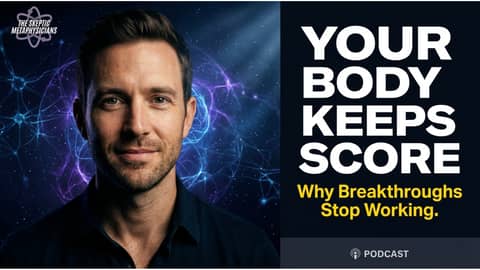
That's the exact conversation we had on a recent episode of The Skeptic Metaphysicians with consciousness teacher and embodiment guide Blaise Kennedy. What came out of it wasn't philosophy. It was a practical, honest, sometimes uncomfortably accurate diagnosis of why so many spiritually motivated people keep spinning their wheels. And more importantly, what to actually do about it.
Your Body Has Been Running a Filing System (Without Your Permission)
Here's the concept that stopped us cold in the episode: your body isn't just a vehicle. It's an archive.
Every unresolved experience, every wound you thought you were "over," every emotional loop that keeps replaying has been quietly cataloged somewhere in your physical system. Not your mind. Your body. Blaise calls it a kind of subtle body filing cabinet, and most of us have been trying to clean out that office without ever opening the drawers.
This is why insight alone doesn't create lasting change. You can have a profound realization in therapy or during a meditation retreat, and still find yourself reacting the same old way three weeks later. The missing piece is somatic integration, which is the process of bringing your body into the conversation with your consciousness.
Science has been catching up here. Somatic therapies, polyvagal theory, and trauma-informed practices all point to the same conclusion: the body holds what the mind conveniently forgets. Dr. Bessel van der Kolk's landmark work The Body Keeps the Score demonstrated that trauma lives in the nervous system, not just in memory. That means thinking your way out of it is, at best, a temporary fix.
The Real Reason You Feel "Spiritually Fluent but Personally Stuck"
Blaise offered a distinction in the episode that deserves to be cross-stitched on a pillow: you can be completely awakened in your upper centers (insight, awareness, expanded consciousness) while still carrying years of unprocessed material in your body.
He described his own awakening at 24 this way. "I had access to, from my neck up. That's what I knew about myself." It wasn't until someone asked him how do you feel, not what do you think, that he realized he had almost no connection to the information his body was carrying.
This disconnect is wildly common, and here's why it happens:
When an experience is too overwhelming to be fully felt (especially in childhood, when we don't have the relational support to process it), the body contracts. It numbs. Consciousness partially leaves the body to protect itself. This is what trauma does. Not all trauma is big-T trauma either. It can be a parent who couldn't hold your anger, a grief nobody helped you feel, a version of yourself that was never quite welcome. Over time, you become a person who lives mostly from the neck up. Highly intelligent, often perceptive, spiritually curious, and yet oddly disconnected from your actual life.
The spiritual path often makes this more pronounced, not less. You get excited by ideas about consciousness, chase more and more insights, and the body, that faithful archivist, just keeps waiting.
Three Handles to Actually Move the Energy
This is where Blaise's framework gets practical. And if you want the full breakdown, this episode is a must-listen. But here's the condensed version of what he teaches:
1. Unify your thinking, feeling, and body sensations. These aren't three separate systems. They're one. Most of us default to one (usually thinking) and run everything through that filter. The practice is to include all three simultaneously, to feel what you think and sense what you feel. This unified awareness is what Blaise calls the "language of the fifth dimension," and it turns out everyone already speaks it. It's the language of presence.
2. Feel more, not less. This one's counterintuitive. When you're frustrated, stuck, or spinning, the instinct is to problem-solve. Blaise's approach is the opposite: feel the frustration more fully. Not wallow in it. Actually inhabit it. "Energy moves because we feel it, not because we solve it," he said in the episode. When emotion is fully felt and received, it completes its cycle. It stops being a stuck loop and starts being useful information.
3. You cannot do this alone. Connection isn't a nice supplement to the healing path. It is the healing path. When your emotional experience is genuinely received by another person, it gets woven back into the fabric of life. It stops being isolated pain and starts becoming integrated wisdom. Blaise compares it to a letter you've been sending that nobody ever received. Of course you keep sending the same one. The solution isn't to stop writing. It's to be heard.
Why Community Is the Force Multiplier Nobody Talks About
Western spirituality has a strange obsession with solo journeys. "The way out is in." "Do the inner work." There's truth in that, absolutely. But Blaise made a compelling case that we've imported Eastern practices built for monasteries and tried to retrofit them for people running businesses, raising kids, and navigating modern life. That's a significant mismatch.
He used a great analogy in the episode: the Olympics. No matter how gifted an athlete is, nobody says, "You're so talented, just go figure out how to ski on your own." Excellence gets paired with great coaching. Motivation gets multiplied by connection.
The same is true of spiritual development. Breakthroughs that happen inside a relational container (a teacher, a group, a community of people all working the same language) are more durable. They integrate. They stick. Because healing, at its core, is a relational wound that needs a relational repair.
Trivia: The George Costanza Principle of Spiritual Growth
Blaise referenced a Seinfeld episode during the interview and it became one of the best metaphors for a healing approach we've heard in a while. In the episode, George Costanza decides to do the exact opposite of every instinct he's ever had. And everything in his life improves immediately.
Blaise's version? When he entered recovery at 24, he realized his entire life strategy had been to maximize pleasure and minimize pain. The result was disconnection, addiction, and a 12-year-old grief over his father's death that his body had been carrying in silence, waiting for permission to finally be felt.
His opposite strategy: embrace what you don't want to feel. Go toward it. That shift changed everything.
The Big Picture: You're Not Behind. You're Just Missing the Body.
Here's what Blaise left us with, and it's the kind of thing that takes a few days to fully settle: we are not just three-part beings (mind, spirit, body) who have been focusing too much on two out of three. We are beings whose wholeness is the access point. Not another insight. Not a new modality. The integration of all of it, thought, emotion, sensation, and connection, into one living, breathing, present experience.
The collective awakening Blaise describes isn't coming. It's already happening. And the role each of us plays is to do the personal work of actually showing up in our bodies, so we stop being islands and start becoming part of something connected.
Ready to hear the full conversation? This episode is one of those that you'll probably listen to twice.
[Listen to the Blaise Kennedy episode on The Skeptic Metaphysicians here.]
If this landed for you, subscribe to the show so you never miss a conversation like this one. We release new episodes regularly across all major platforms. And if someone in your life has been doing all the things and still feeling stuck, share this post. It might be the thing that finally opens the right drawer.
Blaise Kennedy is a consciousness teacher and embodiment guide whose work integrates nervous system science, trauma healing, and relational practices. You can find his work and connect with him via the link in the show notes at SkepticMetaphysician.com.

Producer/Host
Starting his career with NBC/Telemundo, Will ended up as Line Producer, second only to the Executive Producer of a live daily entertainment news show at the Telemundo network in Miami.
In 2005, Will created his own video production company, specializing in corporate video production.
Identifying a need for delivery methods for true branded content in the corporate market place, he created one of the first online TV networks, “iZonOrlando.com”, bringing local television to the world, straight from one of the most visited cities in the world.
In 2011, he was asked to join the production team that produced 19 Kids and Counting and the United Bates of America for TLC and is now the Regional Programming and Video Production Manager for a national TV network where he created Emmy-award nominated programming such as Destination Virginia, Untapped VA, I Do – The Ultimate Wedding Guide, Calm, Cool and Connected, and Living 757.
You're Running on a 9-Year-Old's Script. Here's How to Rewrite It.