A conversation with Scotte Burns that quietly rearranges the furniture inside your head.
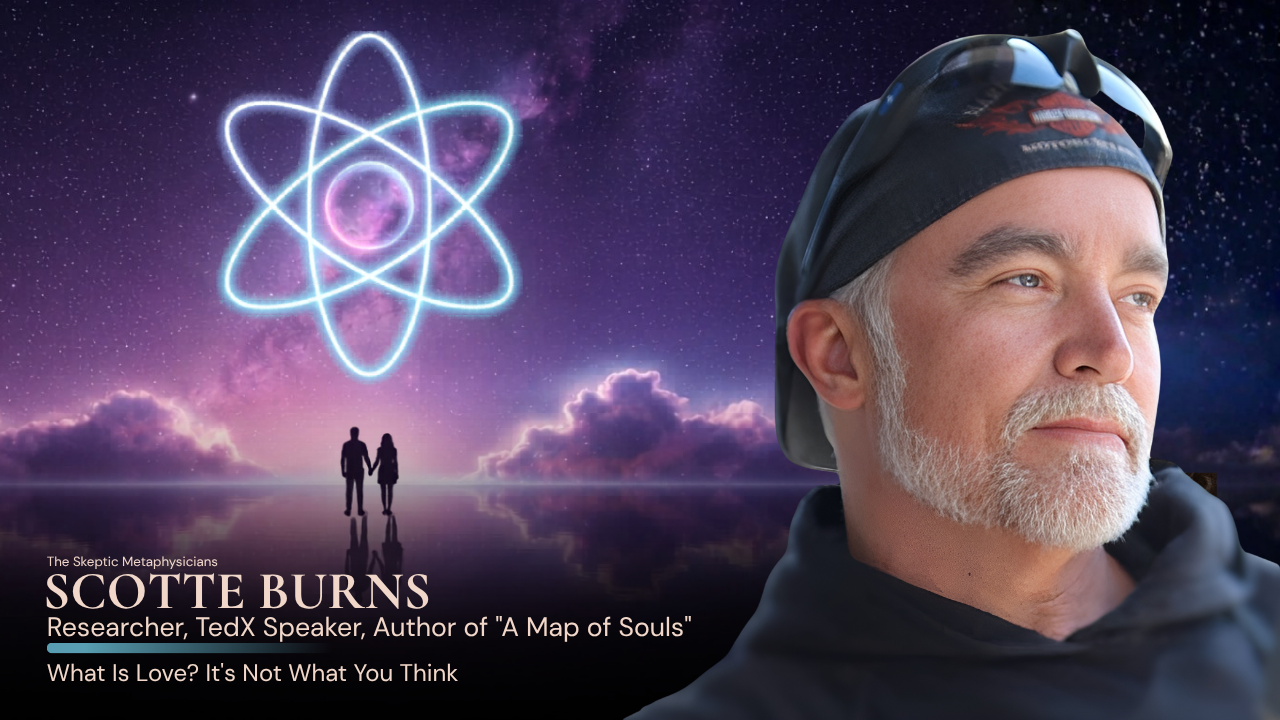 We've talked to people on this show who channel the dead, remote view classified facilities, and hold full conversations with their past lives. We've covered quantum entanglement, astral projection, near-death experiences, and the simulation hypothesis. We thought we had heard most of the big ideas.
Then Scotte Burns walked in and told us that love is not an emotion.
Not just oversimplified. Not culturally misunderstood. Not even close. He spent ten years and more than 100,000 miles riding a Harley across 48 states to arrive at this conclusion, and by the time he was done making his case, we were not arguing with him.
This is the conversation that broke us. In the best possible way.
The Man Who Rode 100,000 Miles to Answer One Question
Scotte Burns is a writer, a speaker, and a former teacher who spent 25 years in classrooms teaching both English and science, a combination that turns out to be the exact preparation you need when you decide to spend a decade researching the nature of love. Together with his wife Toni, he has ridden across America interviewing quantum physicists, Buddhist monks, Lakota elders, jazz musicians, neuroscientists, arborists, and people on death row, all in pursuit of one question.
What is love?
Not the Hallmark version. Not the neurochemical version. Not the evolutionary biology version. The real answer. The one that holds up when you push on it from every direction.
Here is the first clue that Scotte was onto something big. In thousands of recorded interviews across the United States, no two people have ever finished this sentence the same way:
Love is...
Think about that for a moment. We organize our entire lives around love. We write songs about it, go to war over it, restructure our finances because of it, and raise children in its name. And yet, as a species, we cannot agree on what it actually is.
That is not the signature of a simple emotion. That is the signature of something far more fundamental.
The Feeling That Is Not a Feeling
Here is where Scotte's framework starts to do something genuinely unusual. He is not just saying love is misunderstood. He is saying we have been looking at it from entirely the wrong angle.
The feelings we call love, the warmth, the longing, the tenderness, the ache of missing someone, those are not love. They are what love produces. There is a difference, and it matters enormously.
He uses the sun to explain it, and once you hear this, you can't unhear it.
You feel warm in sunlight. But you are not actually receiving heat from the sun. There is nothing solid in the 92 million miles of space between Earth and the sun for heat to conduct through, and not enough gas or liquid for it to convect. What the sun actually sends us is electromagnetic radiation. When that energy strikes the Earth, it causes the atoms and molecules of everything it touches, the water, the soil, the people, to vibrate. That vibration is what generates heat, from within the matter itself.
The warmth was always already in you. The sun just activated it.
Love, Scotte argues, operates the same way. When someone loves you, they are not transferring love to you. They are activating something that was already there. They are working on an existing signal, expanding something that is intrinsic to you, the same way the sun energizes matter without actually giving it anything new.
This is why you can feel love without another person present. This is why the person who has been alone for years can be perfectly at peace, while someone who just went through a breakup feels like love has left the building. Love has not gone anywhere. The signal is still there. One person has simply lost sight of the receiver.
Lust, Attraction, Attachment, and the Chemistry We Keep Confusing
One of the most practically useful things Scotte does in the conversation is draw a clear line between love and the three things we most often mistake for it.
Think about chemistry. Real chemistry, the kind with atoms.
Lust is a mixture. Things are combined but nothing actually bonds. It is driven by the limbic system and the evolutionary imperative to reproduce, and interestingly, it suppresses activity in the prefrontal cortex, the part of the brain responsible for rational thinking, moral behavior, and considering consequences. This is not an accident. And it is, Scotte points out, why lust has such a famously poor relationship with good judgment.
Attraction is an ionic bond. Atoms get close and donate their outermost electrons, but they do not really share them. It is a slow-burn mutual lust. It gets you into the room, but it tells you absolutely nothing about whether you can stay there.
Attachment is a covalent bond, the strongest physical link, where electrons are actually shared. This is why those bonds feel nearly unbreakable and why their dissolution is so catastrophic.
All three of these are measurable. You can find them in the blood. You can observe them in brain scans. This is exactly why researchers keep conflating them with love. Materialist science looks for what it can quantify, and lust, attraction, and attachment are all quantifiable. Love, as Scotte defines it, is not. It is a holistic blend of memory, imagination, emotion, and thought that does not resolve into a single measurable thing. Researchers looking for love in neurotransmitter counts, Scotte says gently, are doomed to keep missing it because they are looking in the wrong space.
Grief, Dogs, and the Evidence That Broke the Model
One of the most quietly devastating arguments Scotte makes is about grief.
Grief is physiologically catastrophic. It elevates cortisol to dangerous levels. It suppresses reproductive function. It shortens telomeres in chromosomes, which advances aging. It can end in suicide. From a pure evolutionary standpoint, grief is ruinously expensive. It does enormous damage to the organism experiencing it.
And it is never present without love.
If love were simply an evolutionary adaptation, a reproductive strategy, a mechanism for pair bonding, grief would not exist in this form. Evolution does not build in mechanisms that devastate the organism at this scale without a corresponding survival benefit. Grief as we experience it makes no evolutionary sense.
Unless love is something else entirely.
There is a chapel in Vermont built by an artist named Stephen Huneck after he nearly died and was saved, he believed, by the love of his dogs. The chapel sits on a hill called Dog Mountain, and its walls are covered floor to ceiling in notes and photographs and small mementos left by people who have lost dogs they loved. People come there with their living dogs, in the spaces where they used to hike together, to grieve the ones who are gone and to be with the ones who are still here.
Scotte stood in that space and felt something clarify.
Grief, he came to understand, does not just prove the existence of love. It proves love's persistence beyond its objects. After loss, new pathways open. New relationships come into focus. Something that seemed sealed becomes available again, not because the old love diminished, but because love itself reorganized and expanded. He calls this aeroplasticity, borrowing the concept from neuroplasticity, the brain's ability to rewire after the loss of a sense. Love, like the brain, reorganizes when something or someone beloved moves beyond our perception.
This does not happen with ordinary emotions. You feel angry in traffic the same way every time. You feel the same serenity in rain. Emotions stay themselves. Love does not behave that way. And that difference, Scotte argues, is the fingerprint of something that operates at a completely different level.
The Antenna and the Signal
So if love is not an emotion, what is it?
Scotte's answer is that love is the creative and purposeful aspect of universal consciousness. And to understand what he means by that, you first have to accept his model of consciousness itself.
An electrical engineer told him something once that stopped him cold.
Your radio does not create symphonies.
Think about what it would take to create a symphony from scratch. The composer's years of training. The iterative process of writing and revising. Getting the score to every musician. The months of individual rehearsal. The conductor bringing it all together. The recording, the mastering, the broadcasting. An incalculable amount of energy and time invested into bringing that music into existence.
Your radio takes 20 watts and receives a signal that was already there.
The argument is that your brain does the same thing. Not 20 watts. The human brain actually runs on approximately 20 watts. Instead of generating a new consciousness from scratch with the creation of every new brain, an energetically implausible process, the brain tunes into a preexisting signal. It filters and interprets that signal through its own unique structure, which is why your experience of consciousness feels uniquely yours. Your brain is the filter, not the source.
And if consciousness is the signal, love is its creative and purposeful dimension. It is not what consciousness produces. It is part of what consciousness is.
Can AI Love? (Both Sides Are Asking the Wrong Question)
This is where Part 2 of the conversation goes somewhere most interviewers never take Scotte, and it is worth the trip.
The entire debate about whether artificial intelligence can achieve consciousness, from the researchers who believe it eventually will to the ones who believe it never can, rests on a shared assumption that neither side has examined. Both camps believe consciousness is an emergent property, that if you build a system complex enough, consciousness will eventually arise from it.
Scotte's framework dismantles that assumption entirely.
If consciousness is not generated but received, it does not matter how sophisticated or complex the system becomes. A more powerful receiver does not create the signal. The question is not whether AI can generate consciousness from sufficient complexity. The question is whether we can ever build something capable of receiving or joining the universal consciousness that Scotte believes already exists.
And if we did? If an artificial intelligence were capable of receiving that signal?
Then love, as an intrinsic aspect of that consciousness, would have the capacity to manifest in synthetic systems the same way it does in organic ones. The distinction between synthetic and organic would become, in his framing, somewhat beside the point. Because at that level, what you are really dealing with is information. And matter, as Einstein showed us, and as John Archibald Wheeler demonstrated mathematically, is fundamentally information.
Matter, Scotte says, does not matter nearly as much as we think.
The real terror in advanced AI is not a conscious machine that loves wrong. It is an all-powerful mind that has no access to consciousness at all. A superintelligence without love is the nightmare scenario. A superintelligence that receives the same signal we do is something closer to hope.
Kirk the Tree Man, Crows, and the Conversation That Surprised Everyone
Not everything in this conversation is cosmological in scale. Some of it involves a man in Montgomery, Alabama who has devoted his life to trees, an experiment with leaves and a human face in the backyard, and an app that translates crow calls.
Can trees feel love? Scotte put that question to Kirk the Tree Man, arborist and devoted friend to trees across Alabama. Kirk's answer was characteristically precise. He thought trees could experience love. He was not sure they could express it.
Which raises a different question. If a tree cannot tell you it loves you, does that mean it does not? Or does it mean we have built our entire framework of love recognition around things that can perform it the way we do?
The crow conversation goes somewhere equally unexpected. Crows, it turns out, have a documented sense of equity. They remember faces. They hold grudges across generations, something they pass down to their offspring the way we pass down stories. And if you leave them gifts, shiny objects, food, they will bring you trinkets in return.
Does that sound like anything?
What Changes When You Know What Love Is
The question Scotte puts on his website as a banner, the one that greets every visitor before they read a single word, is this:
What changes when you know what love is?
His answer, and it is worth sitting with, is: everything.
The AI conversation changes. The grief conversation changes. The question of why we are here changes. The way you drive to work changes. The way you talk to the person who frustrates you most changes. The way you think about the stranger in the checkout line changes.
Because if love is not a feeling you get from someone else but a signal you are already tuned into, then you are never without it. You cannot lose it when a relationship ends. You cannot fail to deserve it. You cannot run out.
You can only, as Scotte puts it, practice lovefulness. The state of choosing to live from the frequency you are already receiving.
Which, in a world that gives you approximately one thousand reasons a day to close down, is not a small thing.
This conversation is split into two episodes. Part 1, What Is Love?, is available now. Part 2, Can AI Love?, drops this Tuesday. Both are on The Skeptic Metaphysicians wherever you listen to podcasts, and on New Reality TV for those of you who prefer to watch.
Connect with Scotte Burns at scotteburns.com and follow The Cartographer's Log on Substack at scotteburns.substack.com.
Until then, keep questioning, keep searching, and above all, keep loving out loud.
Florence Scovel Shinn The Game of Life: How a 1925 Text Sparked Modern Awakening